Driving Digital Resilience Through Artificial Intelligence for IT Operations
Introduction
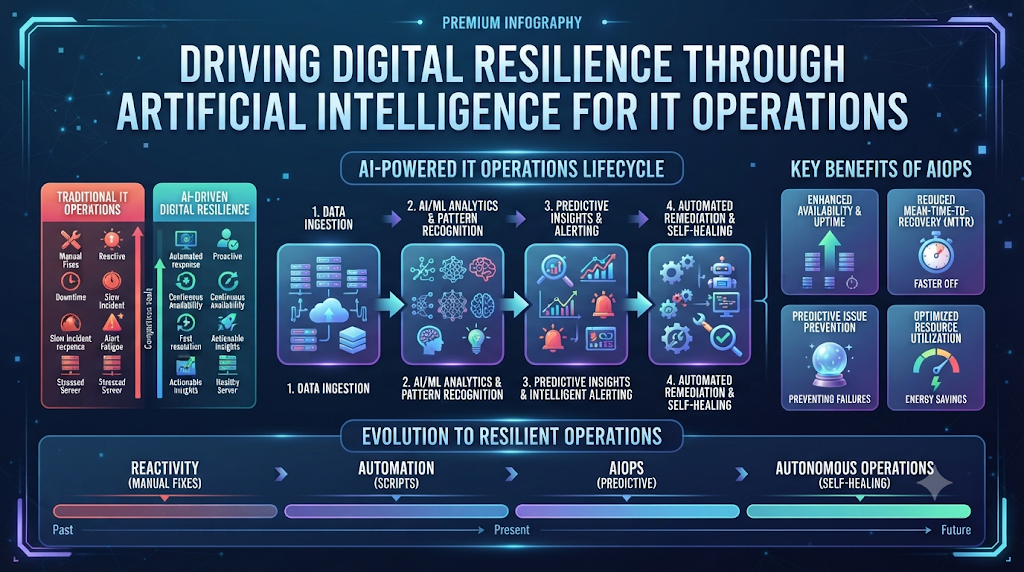
Enterprise technology landscapes expand rapidly, bringing unprecedented management complexity to modern engineering organizations. Traditional monitoring systems generate endless streams of notifications, quickly overwhelming operations teams and trapping them in reactive cycles. Because manual troubleshooting cannot keep pace with distributed cloud architectures, forward-thinking businesses embrace intelligent software solutions. Artificial Intelligence for IT Operations completely revolutionizes how teams process telemetry, analyze system behavior, and resolve outages. Dedicated platforms like TheAIOps.com provide comprehensive digital hubs for professional education, expert consulting, and technical knowledge discovery.
Understanding Artificial Intelligence for IT Operations
Artificial Intelligence for IT Operations integrates massive operational datasets with machine learning models to automate daily administrative workflows. Intelligent platforms ingest continuous telemetry streams and evaluate historical patterns rather than depending strictly on static threshold rules. This advanced approach empowers technical staff to transition smoothly from emergency firefighting toward proactive system governance. Furthermore, these intelligent mechanisms integrate directly with existing monitoring stacks to deliver a unified observability perspective.
Why AIOps Is Becoming Important for Modern IT Operations
Engineers currently manage intricate microservices, elastic cloud deployments, and staggering volumes of operational data. Legacy monitoring utilities handle this immense scale poorly, triggering severe alert fatigue across on-call engineering rotations. Intelligent operations filter out background noise so technical personnel can focus exclusively on high-priority incidents. As system complexity expands continuously, automated insights become vital for preserving high availability and meeting stringent reliability objectives.
What Professionals Can Learn Through AIOps Training
Structured AIOps Training equips practitioners with the practical skills required to design, deploy, and manage intelligent systems. Learners master intelligent monitoring, precise anomaly detection, event correlation, and predictive analytics through hands-on technical exercises. Participants also discover how to construct automated remediation workflows that streamline incident management cycles. This targeted education prepares engineers to handle complex operational roadblocks with absolute confidence.
Understanding AIOps Certification and Professional Skill Validation
Pursuing an AIOps Certification allows technical professionals to validate their expertise and commitment to modern reliability engineering. Certification tracks evaluate knowledge spanning core platform architectures, machine learning basics, and practical tool administration. Although exact prerequisites and exam formats vary by vendor, holding an industry credential demonstrates proven competence to hiring managers. It establishes a clear milestone for engineers seeking career advancement in systems engineering.
Choosing an AIOps Course for Practical Learning
Selecting the ideal AIOps Course demands careful evaluation of your current skill set and career objectives. A comprehensive curriculum addresses foundational concepts, architectural design patterns, real-world operational use cases, and strategic deployment methodologies. Students should target courses that balance theoretical machine learning principles with practical infrastructure troubleshooting scenarios. Platforms such as TheAIOps.com aggregate educational resources to help learners discover relevant learning tracks tailored to their needs.
Exploring AIOps Consulting for Organizations
Organizations planning to adopt intelligent monitoring frequently secure expert external guidance to accelerate their journey. AIOps Consulting helps businesses evaluate current observability maturity, spot automation gaps, and build custom adoption roadmaps. Experienced consultants analyze data readiness, tool compatibility, and internal team capabilities. This external expertise ensures that companies invest budgets into strategies delivering measurable reliability improvements.
Understanding AIOps Services and Their Business Use Cases
Adopting intelligent operations requires far more than merely purchasing commercial software licenses. AIOps Services encompass technology integration, custom dashboard creation, workflow automation design, and ongoing operational support. Common business use cases involve lowering mean time to resolution, preventing repeat outages, and optimizing cloud expenditure. Professional services enable enterprises to fast-track digital transformation initiatives safely and effectively.
| Operational Challenge | Traditional Approach | Intelligent Operations Approach |
| Alert Management | Manual sorting of thousands of raw alerts | Automated event grouping and noise reduction |
| Root-Cause Analysis | Hours spent investigating multiple log silos | Instant event correlation and anomaly pinpointing |
| Incident Response | Reactive scrambling after users report failures | Proactive detection before user disruption happens |
Exploring AIOps Tools for Intelligent IT Operations
Vendors offer numerous AIOps Tools designed to help teams ingest, analyze, and act upon operational metrics. Organizations must evaluate products based on data integration breadth, scalability limits, and overall usability. Certain utilities concentrate heavily on log analytics, whereas others specialize in metric anomaly detection or automated incident response. Choosing the correct solution depends entirely on your specific infrastructure stack and operational requirements.
Understanding What an AIOps Platform Does
An AIOps Platform functions as the central analytical engine processing all operational telemetry streams. It ingests logs, metrics, and traces from disparate systems to establish accurate operational baselines. Applying machine learning algorithms allows the platform to detect subtle anomalies that standard rules-based monitors miss completely. It then correlates related alerts into a single cohesive incident ticket, dramatically lightening the workload for engineers.
Planning and Managing AIOps Implementation
A successful AIOps Implementation demands a deliberate, phased strategy instead of a disruptive overnight overhaul. Teams should launch initiatives by defining concrete operational goals, such as reducing alert volume or accelerating incident response. Next, organizations must audit existing monitoring data sources to verify high data quality. Introducing automation gradually allows teams to build system trust and manage internal organizational change smoothly.
Understanding the Role of an AIOps Engineer
An AIOps Engineer bridges traditional system administration, data science, and software engineering disciplines seamlessly. These professionals build monitoring pipelines, tune machine learning models, and script automated remediation workflows. Essential competencies include strong proficiency in cloud infrastructure, scripting languages, observability tools, and systems troubleshooting. As enterprises modernize, demand for engineers fluent in both IT operations and machine learning surges upward.
How AIOps Supports Monitoring, Observability, and Incident Management
Traditional monitoring informs you when a system fails, whereas modern observability helps you understand underlying causes. Intelligent operations enhance both domains by layering predictive analytics directly onto raw telemetry data. During active outages, integrated incident management workflows automatically route correlated alerts to the appropriate response team. This fluid integration minimizes downtime and strengthens overall service reliability.
Using AIOps For Anomaly Detection and Event Correlation
Modern enterprise environments generate millions of telemetry data points every minute, making manual inspection entirely impossible. Anomaly detection algorithms establish normal baseline behaviors and flag unusual deviations instantly. Event correlation then groups hundreds of related alerts into a single root incident container. This powerful mechanism stops engineers from chasing downstream symptoms during high-stress outages.
Understanding Root-Cause Analysis and Predictive Operations
Uncovering the true origin of an IT failure consumes immense time during critical production outages. Root-cause analysis tools parse correlated telemetry across multiple layers to pinpoint exact faulty components. Furthermore, predictive operations leverage historical trend analysis to forecast impending capacity bottlenecks or hardware degradations before failures occur. These proactive features transform IT personnel from reactive firefighters into strategic architects.
Exploring Automated Remediation and Operational Automation
Automated remediation elevates intelligent operations by resolving known infrastructure issues without human intervention. When platforms detect specific anomalies, they trigger predefined scripts or orchestration workflows to fix the problem instantly. Operational automation cuts human error, accelerates recovery times, and frees engineers for high-value strategic projects. Teams must always deploy automation cautiously alongside robust safety guardrails.
How AIOps Connects AI, Machine Learning, Data, and Automation
Intelligent IT operations rely entirely on the powerful synergy of several advanced technologies operating in unison. Artificial intelligence and machine learning models process massive streams of big data generated by modern cloud architectures. Observability utilities supply raw telemetry inputs, while automation engines execute necessary corrective tasks. Understanding this interconnected ecosystem empowers anyone building a career as an AIOps Engineer.
Building a Practical AIOps Learning and Adoption Roadmap
Establishing a structured roadmap ensures steady progress whether you operate as an individual learner or an enterprise organization. Begin by mastering foundational competencies in monitoring, scripting, and basic data analysis. Next, investigate specific platform tools, architectures, and deployment methodologies through targeted courses. Finally, apply your knowledge to real-world environments to cultivate practical competence over time.
How TheAIOps.com Supports AIOps Learning and Knowledge Discovery
Navigating the fast-moving landscape of intelligent IT operations proves challenging without a centralized resource. TheAIOps.com functions as a dedicated platform combining educational curricula, consulting insights, and implementation guidelines. Whether you seek an AIOps Course, examine certification pathways, or research enterprise tools, the platform delivers clear, structured knowledge to drive your success.
Why Reliable AIOps Information Is Becoming More Important
As artificial intelligence reshapes the technology sector, accurate and practical information becomes exceedingly valuable. Market hype frequently obscures the realistic capabilities of modern operational software. Dependable educational materials help professionals distinguish vendor marketing claims from genuine technical implementation strategies. Focusing on foundational principles and real-world utility enables teams to build sustainable, intelligent operations practices.
Frequently Asked Questions About TheAIOps.com
How does TheAIOps.com serve technology professionals?
The platform operates as a dedicated learning, consulting, and knowledge hub centered on Artificial Intelligence for IT Operations, helping teams master advanced workflows.
Who benefits most from engaging with AIOps Training?
IT professionals, DevOps engineers, site reliability specialists, system administrators, and technical managers acquire critical execution skills through structured programs.
What value does an AIOps Certification provide?
Holding a recognized credential validates an engineer’s technical proficiency across intelligent monitoring, automated event correlation, and anomaly detection.
What curriculum elements appear inside a standard AIOps Course?
Comprehensive courses teach fundamental architectures, underlying technologies, real-world operational use cases, deployment strategies, and troubleshooting methods.
In what ways do companies utilize AIOps Consulting?
Consulting engagements assist businesses in auditing existing observability stacks, identifying automation opportunities, and formulating tailored adoption roadmaps.
What solutions are typically delivered through AIOps Services?
Offerings include technology integration, observability configuration, workflow automation development, dashboard creation, and ongoing operational support.
What evaluation metrics matter when selecting AIOps Tools?
Teams should weigh data integration depth, observability features, event correlation accuracy, scalability limits, and overall platform usability.
What core operational duty does an AIOps Platform handle?
Platforms ingest telemetry streams, reduce notification noise, detect baseline anomalies, correlate related events, and automate mitigation responses.
What key milestones define an AIOps Implementation project?
Phased rollouts involve setting operational targets, auditing data sources, filtering alert noise, configuring event correlation, and measuring outcomes.
What foundational technical skill set defines an AIOps Engineer?
Engineers require proficiency in monitoring systems, cloud environments, automation scripting, data analysis, machine learning concepts, and incident management.
Final Thoughts
Artificial Intelligence for IT Operations marks a profound evolution in how modern enterprises manage system reliability and scale. Fusing machine learning, big data, and automation allows teams to defeat alert fatigue and resolve incidents rapidly. Continuous education remains paramount whether you are an individual engineer pursuing an AIOps course or an organization planning an enterprise rollout. Platforms like TheAIOps.com remain dedicated to providing the knowledge, training resources, and guidance required to excel in this dynamic technical domain.
Leave a Reply